
Vedanta Ltd's aluminium plant in Jharsuguda, Odisha, is under regulatory scrutiny by the state's Water Resources department regarding its water sources and drawal history. This follows a complaint alleging unauthorised groundwater extraction and previous financial demands for illegal water use, with the National Green Tribunal also seeking responses on environmental concerns.

Delhi is experiencing heavy rainfall and strong winds, prompting the India Meteorological Department (IMD) to issue a red alert, which is impacting ongoing preparations for the crucial BRICS Summit.
The Maharashtra Pollution Control Board (MPCB) has ordered the shutdown of 19 ready mix concrete plants in the Mumbai Metropolitan Region for violating environmental guidelines and contributing to deteriorating air quality levels.

Heavy rainfall in Delhi led to widespread waterlogging, traffic disruptions, and a significant drop in minimum temperatures across the city. Key areas like Lutyens' Delhi, Supreme Court, and AIIMS were affected, while the air quality remained satisfactory.

Haryana is institutionalising drone technology as a key governance tool, deploying AI-powered surveillance and high-resolution geospatial mapping. This initiative aims to detect illegal constructions, monitor mining activities, map civic infrastructure, and track pollution across the state. The Chief Secretary reviewed progress on various projects, including an AI-powered Change Detection Application and digital mapping of municipal assets, highlighting the state's commitment to evidence-based governance and improved public service delivery.

The Anti-Corruption Branch has sought judicial custody for former Delhi minister Satyendar Jain, ex-Delhi Jal Board CEO Udit Prakash Rai, and three others in a corruption case related to alleged irregularities in the tendering process for Delhi Jal Board's sewage treatment plant projects. The accused's counsels have challenged the arrests, with Jain's lawyer planning a bail plea.

Delhi's air quality deteriorated to the 'severe' category, prompting the implementation of Stage-IV GRAP measures and hybrid classes for schools.

Chief Justice of India considers shifting Supreme Court hearings to virtual mode due to severe air pollution in Delhi after experiencing its effects firsthand.

Delhi's air quality deteriorates to 'very poor' levels, sparking a blame game between AAP and BJP over the causes and responsibility for the pollution.
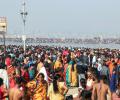
The National Green Tribunal on Wednesday slammed the Uttar Pradesh Pollution Control Board, asking whether it disputed the Central Pollution Control Board's finding on high levels of faecal coliform being found in the water at various locations in Prayagraj during the ongoing Mahakumbh.
Delhi government mandates 50% work from home for offices and private establishments under GRAP stage three due to severe air pollution. Essential services are exempted.

Uttar Pradesh Chief Minister Yogi Adityanath asserted that Uttar Pradesh enjoys a clean environment, unlike Delhi, which he likened to a 'gas chamber' due to its pollution levels.
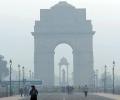
'Most pollution boards across the country have unused funds. There is practically no reason why pollution should not be a political priority.'

Uttar Pradesh Chief Minister Yogi Adityanath on Wednesday dismissed concerns regarding faecal contamination in the waters at Triveni Sangam, stating that continuous monitoring and purification processes ensure its quality.
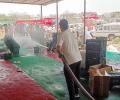
An explosion at a firecracker factory in Madhya Pradesh's Dewas district resulted in multiple fatalities and injuries, prompting investigations and government action.

The Supreme Court issued interim directions permitting the sale and bursting of green firecrackers in Delhi and the National Capital Region (NCR) during Diwali, outlining specific rules and restrictions.

On the weather front, dense fog led to a sharp drop in visibility, with Palam recording 50 metres visibility under dense fog conditions with west-southwesterly winds at 5 kmph at 8 am, while Safdarjung reported 100 metres visibility with calm winds at the same time.

The clinics are expected to operate for at least two hours daily, particularly between September and March -- the period when air pollution levels are typically high.
Of 817 grossly polluting factories, 62 have not installed anti-pollution devices and in 84 units, the installed devices are non-functional.

The Indian government has announced staggered working hours for its employees in Delhi due to the severe air pollution in the city. The move comes after a week of 'severe' pollution levels, which have slightly improved but are still in the 'very poor' zone. The order also encourages employees to pool vehicles and use public transport to minimize vehicular pollution.

The waste disposal at the plant in Dhar district's Pithampur industrial area was undertaken following directives of the Madhya Pradesh high court.

With the Air Quality Index remaining in the severe category, the government has directed schools to switch to online mode for these grades until further notice.

Following a deadly explosion at a firecracker factory in Madhya Pradesh, authorities have invoked the National Security Act against the factory manager and filed culpable homicide charges against four individuals, including the owner.
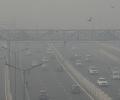
Delhiites continued to breathe toxic air on Tuesday as the air quality edged closer to the severe zone in some areas.

The Indian education ministry has undergone a significant reshuffle of top officials, including the removal of higher education secretary Vineet Joshi, amidst widespread controversies surrounding NEET-UG paper leaks and CBSE digital evaluation glitches, with the opposition demanding the resignation of Minister Dharmendra Pradhan.

The Supreme Court of India has directed the NHAI and MCD to consider relocating or temporarily closing toll plazas at Delhi's borders to alleviate traffic congestion and reduce air pollution. The court also addressed school closures and financial aid for construction workers affected by pollution control measures.

The Supreme Court on Wednesday asked the Commission for Air Quality Management (CAQM) to consider directing schools in Delhi-NCR to postpone open air sports competitions planned in November and December to 'safer months' keeping in mind air pollution levels.

The Environment and Forest Ministry has decided to seek bank guarantee for revocation of its orders for closure of industrial units and projects on ground of causing environment pollution.

A recent survey reveals that a significant number of households in Delhi-NCR are experiencing health problems due to the worsening air quality, with residents reporting symptoms like sore throat, cough, and burning eyes.

The Delhi Pollution Control Committee (DPCC) reports improved air quality in Delhi compared to the same period last year, attributing it to coordinated efforts by government departments. Officials aim to avoid implementing GRAP Stage III restrictions through proactive measures and public participation.

Mundane as it may seem, this is in some ways a metaphor for the challenges facing the nation, argue Arvind Subramanian and Devesh Kapur in their new book, A Sixth Of Humanity.

The Delhi High Court has asked the central government why it cannot reduce the GST on air purifiers, considering the poor air quality in Delhi. The court's concern is that the current 18% GST makes air purifiers unaffordable for the common man.
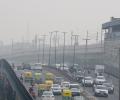
'The pollution has increased. We are facing breathing problems and irritation in the eyes'
The survey was conducted in 88 major industrial clusters in the country.

The order will be effective till March next year for the festivals that require immersion of idols of deities, including those made of Plaster of Paris (PoP).

Billions of rupees spent on river cleaning programmes have gone down the drain. This situation cannot be allowed to continue, says Business Standard.
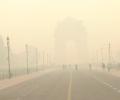
Delhi residents woke up on Tuesday to heavy grey haze darkening the city skies, reduced visibility and the air quality in the 'red zone' after many celebrated Diwali last night by bursting firecrackers beyond the two-hour limit set by the Supreme Court.

Delhi choked under a thick blanket of smog on Monday, with the Air Quality Index (AQI) settling at 498, which falls in the higher spectrum of 'severe' category.
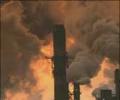
The Central Pollution Control Board has declared Gujarat as the most polluted state in India.

Clean air needs action all year round; and that it will work only if we act jointly and at scale, asserts Sunita Narain.
